

 © ABIR ROY BARMAN/shutterstock.com
Overview
The region maintains extensive forest cover—averaging nearly half of its total geographical area—and features hundreds of high-altitude glacier-fed lakes. Its iconic species include the snow leopard, red panda, Himalayan tahr, musk deer, clouded leopard, Tibetan blue bear, Pallas's cat, Himalayan lynx and gaur, alongside recently confirmed camera-trap records of the Bengal tiger at high elevations. The landscape is also a globally significant centre for orchid and rhododendron diversity and hosts nearly half of India’s butterfly species.
This landscape also faces a layered set of pressures. Unplanned infrastructure development— particularly hydropower dams, road networks and transmission corridors—is fragmenting forests and high-altitude habitats. Accelerating climate change is reshaping the cryosphere through glacier retreat and altered snow regimes; the 2023 Glacial Lake Outburst Flood (GLOF) of the South Lhonak Lake illustrated the cascading risks such changes pose to downstream ecosystems and communities.
Unregulated tourism and the associated accumulation of solid waste are degrading riparian and alpine systems along major circuits. At higher elevations, this unmanaged waste sustains populations of free-ranging dogs, which prey on native ungulates and increase disease and competition pressures on apex predators such as snow leopards. Furthermore, shifts in pastoral use are altering rangeland conditions, while at lower elevations, human–bear conflict remains a persistent concern. These pressures compound one another, disproportionately affecting mountain communities whose livelihoods, water security and cultural identity are tied to ecosystem health.
 © WWF-India
OUR WORK – Khangchendzonga Landscape

KEY PILLARS OF OUR WORK:
WWF-India supported the Sikkim Forest Department in the state’s first systematic snow leopard population estimation, combining structured camera-trap surveys with rigorous spatial modelling. The surveys also yielded valuable records of co-occurring predators, including the Eurasian lynx and Tibetan blue bear. Building on this baseline, WWF-India has co-developed a science-based conservation plan for snow leopards in Sikkim, anchored in structured engagement with high-altitude Brokpa and Dokpa pastoral communities on rangeland stewardship. It also continues to support long-term monitoring and research across Sikkim’s northern, eastern and western ranges.
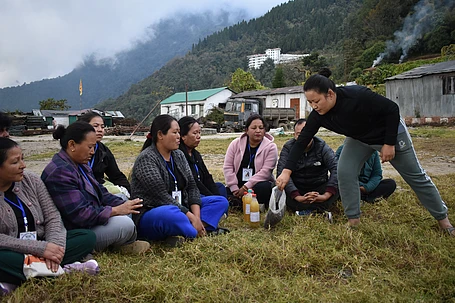
In partnership with the forest departments of Sikkim and West Bengal, WWF-India has mapped red panda distribution at a landscape scale. Approximately two-thirds of suitable red panda habitat lies outside the formal protected area network—a finding that has fundamentally redirected conservation efforts towards community and reserve forests. WWF-India now supports occupancy and genetics-based monitoring, habitat assessment and locally led stewardship in these forests, working with village institutions to build a distributed conservation network for a species that depends on habitat continuity across governance regimes.
Launched in 1996, Project SERVE (Save the Environment and Regenerate Vital Employment) is WWF-India’s flagship community-led forest restoration programme in the Darjeeling hills. Over the last three decades, the programme has regenerated degraded hillslopes, stabilised micro-watersheds and established a replicable model of restoration that integrates ecological objectives with rural livelihoods. Today, Project SERVE stands as one of the longest-running landscape restoration initiatives in the Eastern Himalayas, with outcomes increasingly visible in forest recovery, soil stability on tea-garden slopes and restored water availability in spring-sheds and downstream villages.
In key red panda habitats, WWF-India supports forest restoration, spring rejuvenation and improved cookstoves that cut firewood consumption by 50%. Apiculture and hothouse cultivation were introduced to diversify rural incomes through sustainable honey and year-round crop production. These widely accepted interventions reduce forest pressure while enhancing household health, water security and livelihood resilience, complementing Project SERVE by extending community stewardship across Sikkim and the Darjeeling landscape.
WWF-India drafted the Sikkim State Ecotourism Policy for the Government of Sikkim in collaboration with the Ecotourism and Conservation Society of Sikkim (ECOSS). This policy is grounded in conservation principles. Implementation support continues through capacity-building programmes with the Khangchendzonga Conservation Committee, ECOSS and other community institutions, strengthening the skills of tourism service providers and building an ecotourism sector that sustains rather than erodes the landscape’s ecological and cultural values.
WWF-India engages dozens of schools across Sikkim and the Darjeeling hills through awareness camps, nature appreciation workshops and nature walks. This develops a robust Peer Educators System in which students become long-term advocates for sustainable lifestyles in their communities. This engagement complements wider advocacy on sustainable waste management, where WWF-India contributes to policy advocacy, technical assistance and public campaigns across the Himalayan region.
 © shutterstock.com
Support Conservation
Your contribution helps us in protecting wildlife, restoring habitats and building a better future for people and nature.
Donate